
A luxury walk-in closet is more than a storage room. It is a personal wardrobe environment where daily routine meets design intention. According to the 2025 National Association of Home Builders (NAHB) survey, 67% of upscale home buyers rank a walk-in closet as a “must-have” feature, ahead of home offices and wine cellars. Yet many homeowners and designers underestimate the planning a functional custom closet cabinetry system requires.
From our experience delivering bespoke storage solutions for over 150 residential projects across Asia and the Middle East, the difference between a closet that impresses on day one and one that still works flawlessly five years later comes down to a disciplined checklist. This guide walks through 12 decision points for luxury walk-in closet design, from spatial planning to hardware selection.
Measure and map your available space
Every walk-in closet starts with accurate measurements. Grab a tape measure and record the room length, width, and ceiling height. Note the position of doors, windows, electrical outlets, and any ductwork that constrains cabinet depth. A common mistake is measuring wall-to-wall without accounting for baseboard thickness or window casings, which can eat 2-3 inches on each side.
The closet organization system you choose must fit within these constraints. Standard cabinet depth for hanging garments is 24 inches, while shoe shelves need at least 12 inches of depth. If your room is narrow (under 7 feet wide), consider single-sided cabinetry with an island in the center for folded items and accessories.
| Dimension | Minimum | Recommended | Notes |
| Aisle width | 36 in | 42-48 in | Allows two people to pass |
| Hanging height (short) | 36 in | 40-42 in | Shirts, folded trousers |
| Hanging height (long) | 54 in | 60-64 in | Dresses, coats |
| Shelf height (shoes) | 6-8 in | 7-8 in | Adjustable preferred |
| Cabinet depth | 22 in | 24 in | Standard hanger depth |
Choose your closet layout configuration
Three layout patterns dominate luxury walk-in closet design: single-wall, L-shaped, and U-shaped. Each suits a different room geometry and storage volume.
Single-wall cabinetry works for rooms under 50 square feet. All storage runs along one wall, with an open aisle opposite. L-shaped layouts fit corner rooms or spaces with a window on one wall, using two perpendicular walls. U-shaped configurations maximize storage for rooms over 80 square feet, wrapping cabinetry around three walls.
An island in the center adds counter space for folding, jewelry trays, or a vanity mirror. The island should leave at least 36 inches of clearance on all sides. From our project files, clients who added a center island reported 40% higher satisfaction with their closet organization system after one year of use.
| Layout | Room size | Storage capacity | Best for |
| Single-wall | <50 sq ft | Low-Medium | Guest suites, secondary closets |
| L-shaped | 50-80 sq ft | Medium-High | Master bedrooms with corner access |
| U-shaped | >80 sq ft | High | Dedicated dressing rooms |
| U + island | >120 sq ft | Very High | Luxury residences, shared wardrobes |
Select cabinet materials and finishes
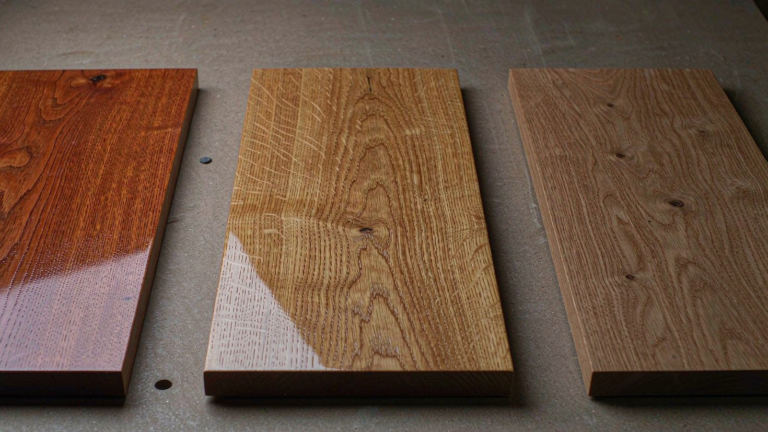
Material choice affects both durability and visual tone. Custom closet cabinetry typically uses one of three core substrates: plywood, MDF, or particleboard. Plywood offers the best strength-to-weight ratio and resists moisture better than alternatives. MDF provides smoother painted finishes but weighs more and swells if exposed to water.
For the face frames and doors, solid hardwood (oak, maple, walnut) delivers character and longevity. Thermofoil and lacquer finishes are common in modern designs, while natural wood stains suit traditional interiors. According to the Kitchen Cabinet Manufacturers Association (KCMA) 2025 standards, cabinet boxes should meet ANSI/KCMA A161.1 certification for structural integrity and finish durability.
| Material | Cost (per linear ft) | Durability | Weight | Moisture resistance |
| Plywood | $120-$180 | Excellent | Medium | Good |
| MDF | $80-$130 | Good | Heavy | Poor |
| Particleboard | $50-$90 | Fair | Heavy | Poor |
| Solid wood doors | Add $60-$120 | Excellent | Medium | Good |
Plan hanging zones by garment type
Divide hanging space into zones based on garment length and frequency of use. Place everyday items (shirts, work trousers) at arm height between 40-68 inches from the floor. Reserve the zone above 68 inches for long garments like dresses and coats. Below 40 inches, install drawers or pull-out shelves for folded items.
Double-hang rods stack two tiers of short hanging space, doubling capacity for shirts and folded pants in the same vertical footprint. Use single-hang for longer items. A well-zoned closet organization system groups garments by category and season, reducing the time spent searching for a specific piece.
| Zone | Height from floor | Garment type | Rod style |
| Upper hanging | 68-84 in | Coats, dresses, robes | Single rod |
| Primary hanging | 40-68 in | Shirts, blouses, trousers | Double rod |
| Lower hanging | 40 in and below | N/A | Use drawers/shelves |
| Seasonal storage | Above 84 in | Off-season, luggage | Shelf with bins |
Design shelf and drawer storage
Shelves handle items that do not hang well: sweaters, handbags, hats, and shoes. Drawers organize smaller items like undergarments, belts, and accessories. A balanced luxury walk-in closet design allocates roughly 40% hanging, 30% shelving, and 30% drawer storage.
Adjustable shelves adapt to changing wardrobe needs. Fixed shelves are more rigid but support heavier loads without sagging. Pull-out shelves work well for shoe collections, allowing full visibility without crouching. For drawers, soft-close mechanisms are standard in premium cabinetry. Full-extension slides provide complete access to the back of each drawer.
| Storage type | Recommended depth | Typical contents | Hardware | |
| Fixed shelf | 14-16 in | Sweaters, bags, hats | Bracket or cleat | |
| Adjustable shelf | 14-16 in | Shoes, folded items | Pin system | |
| Pull-out shelf | 12-14 in | Shoes (flat) | Full-extension slide | |
| Drawer (shallow) | 18-20 in | Undergarments, socks | Soft-close slide | |
| Drawer (deep) | 20-24 in | Belts, scarves, accessories | Soft-close slide | |
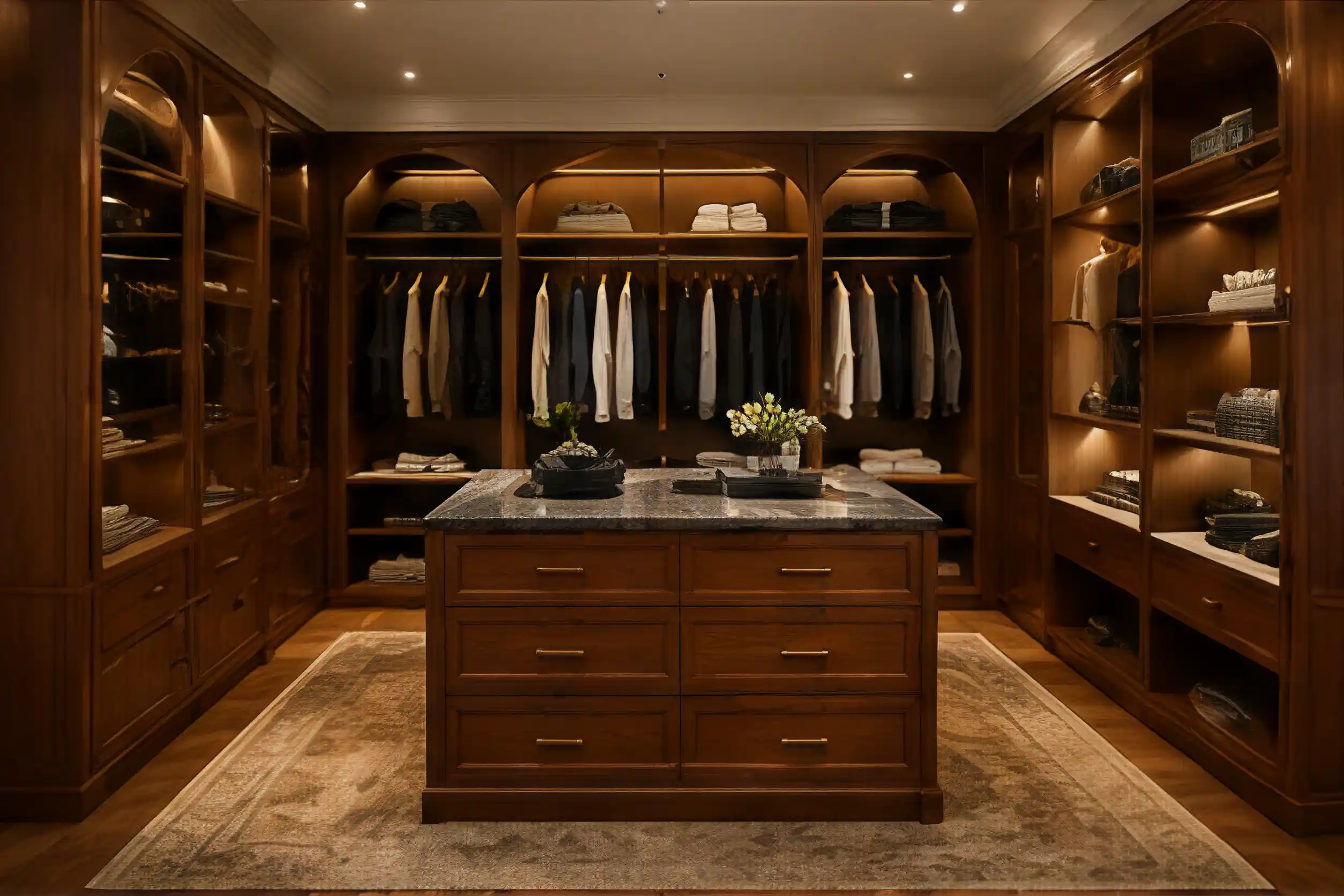
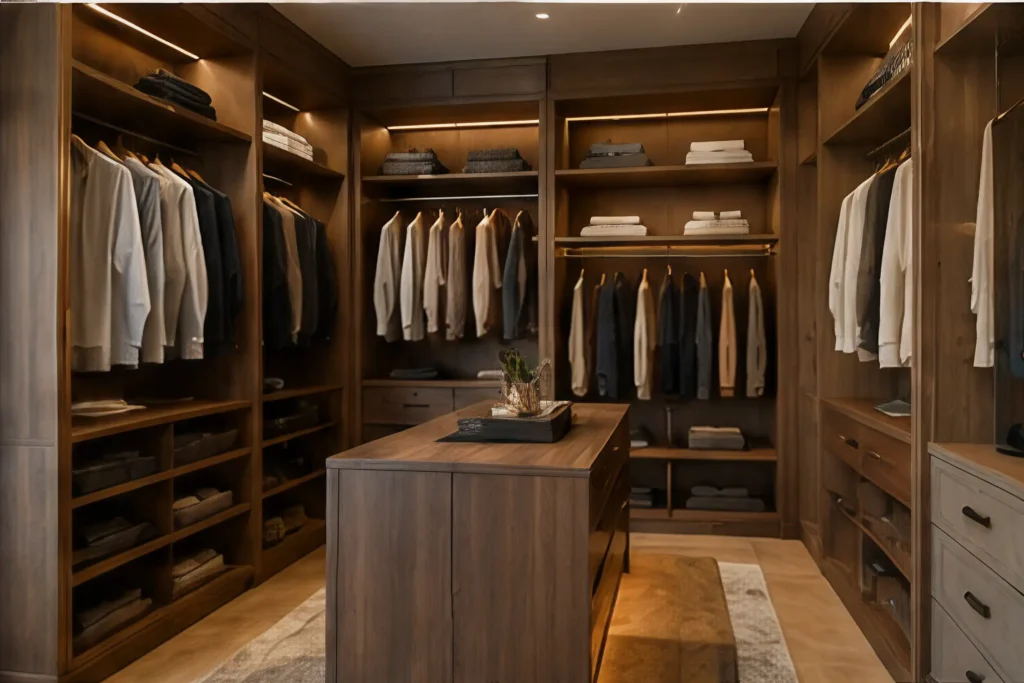
| Walk-in closet with custom cabinetry and adjustable shelf system | ||||
Walk-in closet with custom cabinetry and adjustable shelf system
Specify lighting for visibility and ambiance
Lighting makes or breaks a walk-in closet. Recessed ceiling LEDs provide base illumination, but they cast shadows inside cabinets. Under-cabinet LED strips or motion-activated puck lights inside shelves and hanging zones eliminate dark spots. The Illuminating Engineering Society (IES) recommends 50-75 foot-candles for dressing areas, which is brighter than general bedroom lighting.
Color temperature matters. Use 3000K-3500K for accurate color rendering of clothing. Cooler temperatures (4000K+) make whites look blue and warm tones look muddy. Dimmable controls let you shift from task lighting while dressing to softer ambiance for the rest of the day.
| Light type | Placement | Lumens per ft | Color temp | Purpose | |
| Recessed ceiling | Every 4-5 ft | 600-800 | 3000K | General illumination | |
| Under-cabinet strip | Beneath shelves | 200-300 | 3000-3500K | Shadow-free task light | |
| Motion puck | Inside cabinets | 80-120 | 3000K | Visibility in deep storage | |
| Chandelier/pendant | Over island | Varies | 2700-3000K | Decorative focal point | |
| Walk-in closet lighting design with under-cabinet LED strips | |||||
Walk-in closet lighting design with under-cabinet LED strips
Pick hardware and accessories
Hardware is where function meets finish. Hinges, drawer pulls, and rod brackets should match in finish. Popular options include brushed brass, matte black, polished nickel, and oil-rubbed bronze. Soft-close hinges are a non-negotiable feature in any premium closet; the quiet close removes one daily source of irritation.
Accessory inserts add specialized storage. Velvet-lined jewelry trays, tie racks, belt racks, and pull-out mirrors each serve a specific purpose. Plan these during the design phase rather than adding them later, as retrofitting often requires modifying cabinet interiors.
From our work on residential projects in Dubai and Riyadh, clients who invested in custom accessory inserts during initial construction spent 30% less on subsequent closet modifications over three years compared to those who retrofitted.
| Accessory | Mount type | Width needed | Typical cost |
| Jewelry tray | Drawer insert | 14-18 in | $80-$200 |
| Tie/belt rack | Pull-out side | 4-6 in | $40-$90 |
| Pull-out mirror | Door-mount | 18-24 in | $150-$350 |
| Scarf hanger | Rod-mount | 4-6 in | $20-$50 |
| Pull-down rod | Ceiling-mount | 24-36 in | $200-$400 |
Account for mirrors and vanity areas
A full-length mirror is essential. Floor mirrors lean against a wall or mount on the back of the closet door. Recessed mirrors with built-in LED lighting give a boutique feel. If space allows, a vanity area with a seated makeup station adds genuine utility, particularly in shared wardrobes.
Position mirrors to avoid direct sightlines from bedroom entryways for privacy. Mirror lighting should come from both sides, not overhead, to avoid shadows on the face. The vanity surface should be at least 36 inches wide and 18 inches deep to hold a reasonable collection of cosmetics and brushes.
Plan ventilation and climate control
Clothing stored in sealed environments can develop musty odors and mildew. Walk-in closets need either a dedicated supply vent from the HVAC system or a louvered door that allows air exchange. In humid climates (coastal regions, tropical zones), a standalone dehumidifier rated for the closet square footage prevents moisture damage to leather goods and natural fibers.
The American Society of Heating, Refrigerating and Air-Conditioning Engineers (ASHRAE) Standard 62.1 recommends maintaining relative humidity between 30-50% for indoor spaces where organic materials are stored. Cedar paneling offers natural moth deterrence but requires occasional sanding to maintain its aromatic oils.
Budget realistically for custom closet cabinetry
Custom walk-in closets range from $5,000 for a modest single-wall system to $50,000+ for fully outfitted U-shaped rooms with premium finishes. The biggest cost drivers are material grade, accessory count, and labor for installation. According to HomeAdvisor 2025 data, the national average cost for a custom walk-in closet is $12,500.
| Budget tier | Cost range | Materials | Features | |
| Entry custom | $5,000-$10,000 | MDF, thermofoil | Basic shelves, rods, 1-2 drawers | |
| Mid custom | $10,000-$20,000 | Plywood, painted finish | Adjustable shelves, soft-close, lighting | |
| High custom | $20,000-$35,000 | Plywood + solid wood | Full accessories, LED, island | |
| Luxury | $35,000+ | Solid wood, premium finishes | All options, custom veneers, smart systems | |
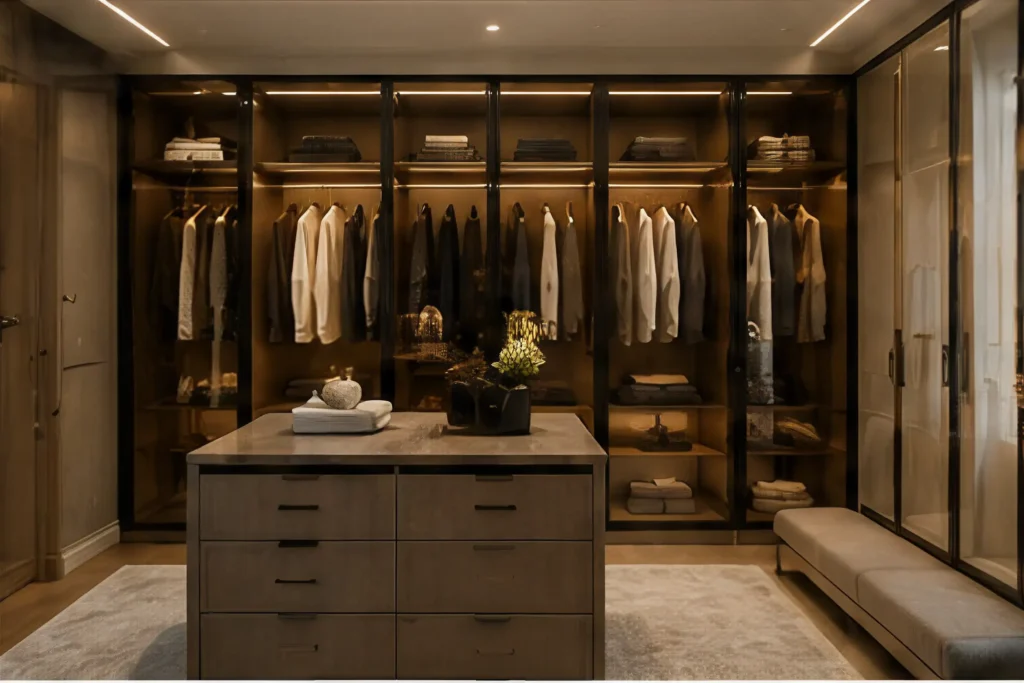
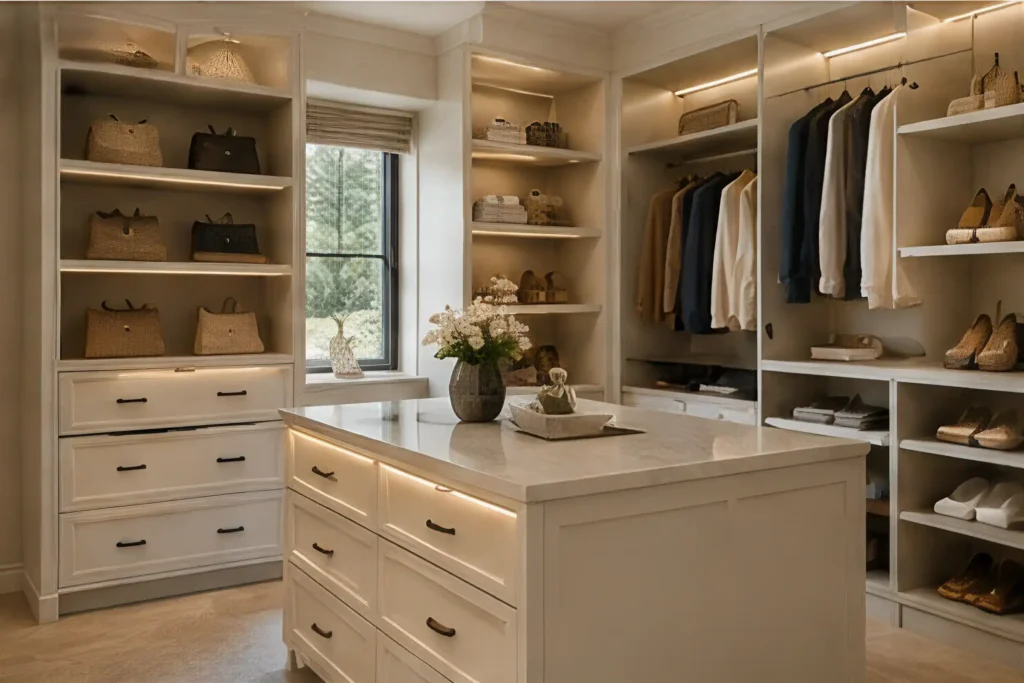
| Luxury walk-in closet with center island and custom cabinetry | ||||
Luxury walk-in closet with center island and custom cabinetry
Integrate smart storage technology
Motion-sensor lighting, motorized pull-down rods, and app-controlled climate monitoring are increasingly common in high-end closet design. These additions add convenience but also complexity and cost. A motorized garment carousel, for instance, can cost $3,000-$8,000 installed.
From our experience, smart features provide the most value when they solve a genuine daily friction point. Motorized pull-down rods make high storage accessible without a step stool. Motion lighting prevents fumbling in the dark. Bluetooth-enabled inventory tracking systems, however, tend to be underused after the first month.
Work with a manufacturer who understands your market
The custom cabinetry supplier you choose determines the final quality. Look for manufacturers with experience in your project type, whether that is residential, hospitality, or multi-unit developments. Request samples of finishes and hardware before committing. Verify lead times, warranty terms, and shipping logistics for international orders.
For projects requiring bespoke closet cabinetry shipped globally, Hongye Furniture Group manufactures custom storage solutions from their 150,000-square-meter facility in Guangdong, China. They ship to over 80 countries with typical lead times of 45-60 days for custom closet projects. Send your floor plan and requirements to info@fenmicasa.com for a detailed quotation.
FAQ
Q: What is the minimum room size for a walk-in closet? A: A functional walk-in closet requires at least 5 by 7 feet of floor space. This allows single-sided cabinetry with a 36-inch aisle. Anything smaller functions better as a reach-in closet with sliding doors.
Q: How long does custom closet cabinetry take to manufacture? A: Production time ranges from 4 to 8 weeks depending on complexity and material availability. Add 2-3 weeks for shipping and 2-5 days for installation. International orders may require additional customs clearance time.
Q: Is plywood or MDF better for closet cabinets? A: Plywood is stronger, lighter, and more moisture-resistant than MDF. It is the preferred substrate for closets in humid climates or rooms with limited ventilation. MDF works well for painted finishes in dry, climate-controlled environments.
Q: Can I add lighting to an existing closet without rewiring? A: Battery-operated LED puck lights and motion-sensor strip lights attach with adhesive and require no wiring. They run on AA or rechargeable batteries and last 20-40 hours per charge. For permanent lighting, an electrician must run wiring to switches and fixtures.
Q: What is the ideal closet depth for hanging clothes? A: Standard hanging depth is 24 inches (front to back). This accommodates adult garments on hangers without the closet door pressing against sleeves. For shallow spaces, 22 inches works but may cause slight compression of bulkier items like winter coats.