
How kiln drying and air drying shape moisture content, stability and the lifespan of your custom furniture.
Every board that becomes a dining table, wardrobe or bed frame starts life full of water. A freshly felled hardwood log can hold more moisture than the wood itself by weight, and how that water leaves the board determines whether your furniture stays straight for decades or twists within a year. This is where kiln dried vs air dried wood becomes more than a technical debate—it is one of the biggest hidden factors behind the price, stability and lifespan of custom furniture.
At Fenmi Casa, our factory in Foshan, Guangdong builds whole-home custom pieces—wardrobes, kitchen cabinets, upholstered beds and dining sets—for villas and luxury projects exported to Latin America, North America and the Middle East. Almost none of that work could survive a long ocean crossing without carefully controlled drying. Below, we explain both drying methods in plain language, compare them side by side, and share the moisture targets we hold our own lumber to.
What Is Kiln-Dried Wood, Exactly?
Kiln drying places stacked lumber inside a large insulated chamber where temperature, humidity and airflow are precisely regulated. Fans push heated air between the boards while vents release humid air and draw in drier air, following a schedule that steps down gradually. A kiln operator tracks moisture meters embedded in sample boards and adjusts the process so water leaves the wood at a pace the fibers can tolerate. For hardwoods, the cycle typically runs from several days to a few weeks, depending on thickness and species.
The controlled finish is what really matters. Because the environment is managed, kiln drying can bring lumber to a precise moisture content—not just dry, but dry to a number. It also sterilizes the wood: sustained heat kills insects, larvae and most mold or fungi that might be living in the sapwood. For export furniture that will sit inside a sealed container for weeks, that cleanliness matters as much as the moisture number itself.
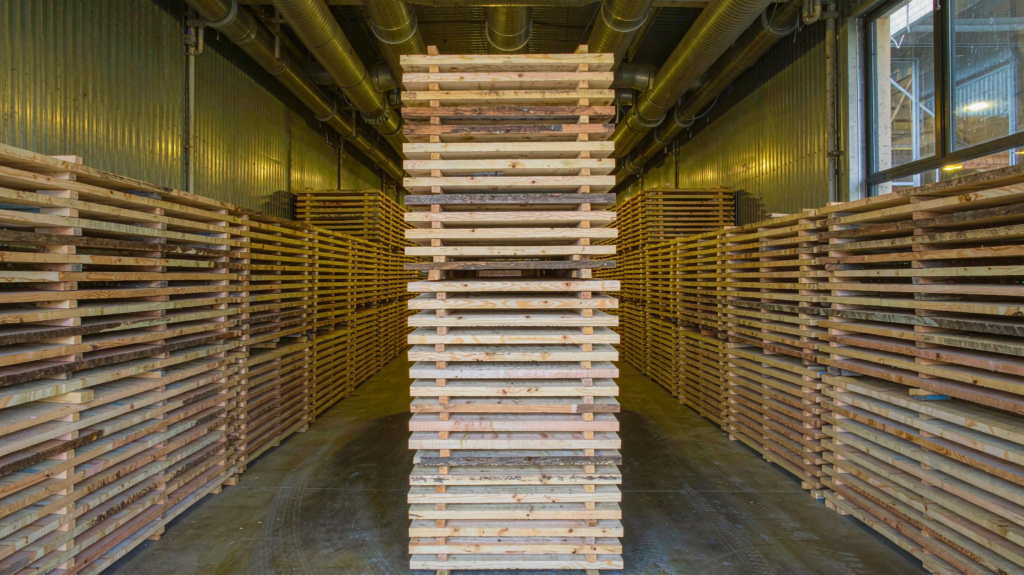
There is a cost side too. Kilns consume energy, need trained operators and represent a serious capital investment, which is part of why kiln-dried lumber is priced higher. But for furniture, that premium buys predictability. Boards arrive at the workshop already near their final working moisture content, so joinery, panels and finished pieces behave the way the drawings say they should—no surprises three months after delivery.
A good kiln schedule is also matched to the species. Dense hardwoods like oak or walnut are dried slowly to avoid internal checking, while softer hardwoods and plantation species tolerate faster cycles. Thickness counts as well, since the center of a thick board lags well behind its surface. This is why a single fixed schedule for everything rarely works, and why an experienced kiln operator remains part of the equipment, not just part of the payroll.
What Is Air-Dried Wood and How Does the Traditional Method Work?
Air drying is the older, simpler craft. Boards are stacked outdoors or under open-sided shelters with small sticks—called stickers—between each layer, so wind can pass freely through the pile. Gravity, sun and moving air slowly pull moisture out over months. There is no fuel bill and no chamber, only time, space and skillful stacking. For roughly 25 mm thick oak, air drying typically takes six to twelve months; denser or thicker stock can need a year or more.
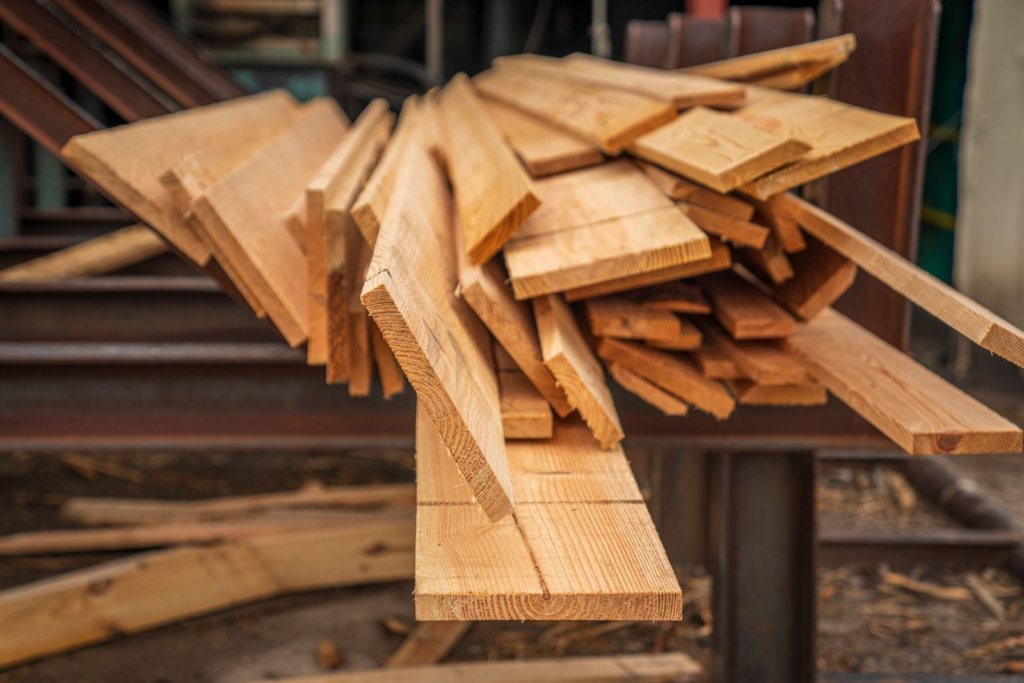
Traditional workshops value air drying for good reasons. Slow, gentle drying puts less stress on some species, and the lumber costs less because nobody is paying for kiln fuel. Well-air-dried boards also develop a character many makers genuinely love. The limitation is the endpoint: wood left outdoors can only dry down to the surrounding climate’s equilibrium moisture content. In a humid summer, that floor sits well above the 8-12% range furniture needs, so air drying alone rarely gets hardwood low enough or clean enough for precision cabinetry.
You will often see lumber sold simply as air dry, with no moisture number attached. That label tells you the wood has shed its free water and will not rot in the stack—but it says nothing about whether the board suits a heated living room or a container crossing the equator. Treat air dry as a starting point, not a specification.
Kiln Dried vs Air Dried Wood: The Differences That Actually Matter
Put the two methods side by side and the trade-offs become clear. Kiln drying is fast, precise and sterile, but it costs energy and money; air drying is cheap and gentle, yet slow, climate-dependent and imprecise. Neither approach is wrong—traditional makers produced beautiful furniture from air-dried stock for centuries. The practical question is what the wood will be asked to do after it leaves the workshop.
It helps to separate the two stages of drying that happen inside any piece of lumber. First, free water sitting in the cell cavities evaporates relatively easily. Then the remaining bound water inside the cell walls must leave, and this is the stage where wood shrinks, stresses build and degrade happens if the process runs too fast. Kilns give you control over that second stage; open air simply gives you whatever the season provides.
| Aspect | Kiln-Dried Wood | Air-Dried Wood |
| Typical drying time | Days to a few weeks for hardwoods | Six to twelve months or more for 25 mm oak; longer for thicker stock |
| Final moisture content | Controlled to a set target, usually 8-12% for furniture | Only reaches the local climate’s equilibrium level; shifts with the seasons |
| Insects, mold and fungi | Killed by sustained kiln heat | May survive; depends heavily on yard conditions |
| Cost and energy | Higher price; kilns consume fuel and power | Lower cost; uses only time, space and airflow |
| Best suited for | Precision joinery, export shipping, heated or air-conditioned interiors | Rough framing, outdoor projects, pre-drying before a final kiln cycle |
In our own production, the honest answer is that the two methods are not rivals but stages. Many hardwood suppliers air dry lumber partway in the yard to remove free water economically, then finish the last, delicate portion in a kiln where the schedule can be controlled to an exact endpoint. That combination protects the wood from surface checks and warp while still hitting the precise moisture number that fine joinery and long sea freight demand. When you compare quotes between makers, it is worth asking exactly where in that journey their boards stopped.
What Moisture Content Should Furniture Wood Be?
For solid wood furniture, the working target for most hardwoods is a moisture content of 8-12%. That range matches the indoor conditions of heated and air-conditioned homes in most temperate regions. If a board enters the workshop wetter than that, it keeps shrinking after the piece is assembled, opening joints, weakening screw hold and cupping wide panels. If it is overdried, it swells instead when it reaches a humid home. The goal is simple to state: dry the wood to match the air it will live in.
Geography shifts the target. In tropical or coastal climates, wood equilibrates naturally at a higher moisture level, so 10-14% is often the more realistic specification—and a board dried to 8% for a desert or heavily heated interior would actually be too dry there. This is why we ask where a client’s project will be installed before finalizing drying targets. A wardrobe headed to the Gulf and one bound for a four-season city should not start from the same number.
| Destination / Situation | Target Moisture Content | Why It Matters |
| Temperate, four-season interiors | 8-12% | Matches heated and air-conditioned homes; keeps joints tight through the year |
| Tropical and coastal regions | 10-14% | Wood equilibrates higher in humid air; reduces swelling and movement |
| Dry or desert interiors | 8% or slightly lower | Limits shrinking and surface cracking in very dry air |
| Weeks inside a shipping container | Boards held at target before packing | Reduces moisture swings during long ocean freight |
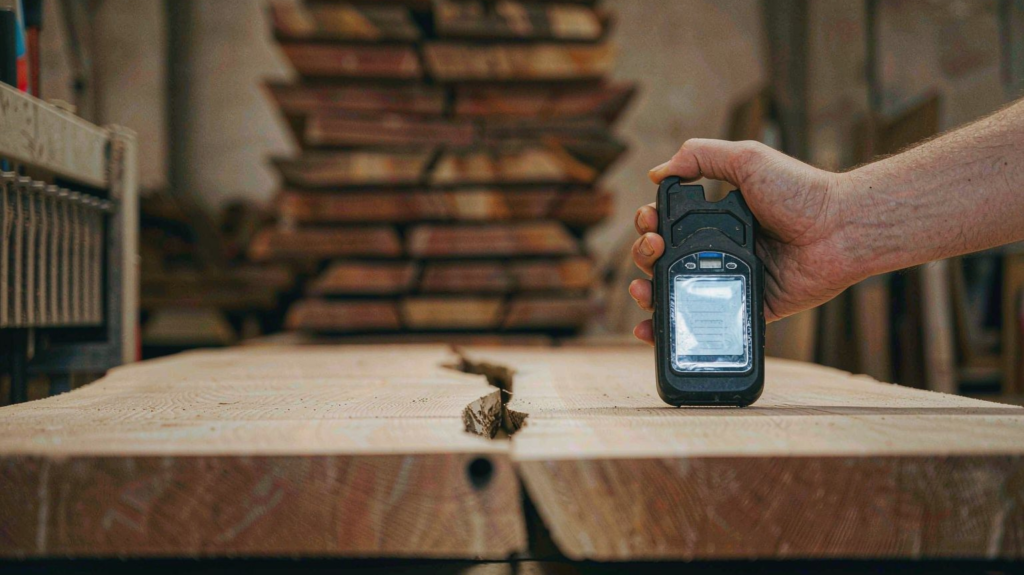
Measuring matters as much as targeting. A moisture meter reads the outer shell of a board easily, but the core of thick stock dries last. Professional practice therefore checks readings across multiple boards from each kiln charge and lets the stack rest—called conditioning—so moisture evens out before machining. Skipping that rest is a common reason furniture measures fine on delivery yet starts moving a month later.
Is Kiln-Dried Wood Better for Custom Furniture?
For most custom furniture, yes—kiln-dried lumber is the safer specification. Precision joinery, wide solid panels and any piece crossing the ocean all benefit from wood that arrives at an exact moisture target, free of insects and with drying stresses released. Air-dried wood can still make excellent furniture when it is properly finished in a kiln afterward, but relying on air drying alone leaves far too much to the weather.
That said, better always depends on the job. For outdoor structures, garden furniture in naturally durable species, or rustic pieces where movement is part of the character, well-air-dried stock can be perfectly appropriate and easier on the budget. The problems appear when air-dried-only wood is used for tight-fitting interior cabinetry: doors that warp out of flat, drawers that bind in humid summers, and finishes that check as the substrate moves underneath.
When you evaluate a maker, the question to ask is not simply whether the wood is kiln dried, but to what number, verified how, and rested for how long before machining. A confident workshop answers without hesitation. Evasive answers about drying are, in our experience, one of the most reliable early warnings of furniture that will not stay flat.
| Your Project | Recommended Drying Spec | Reasoning |
| Whole-home cabinetry and wardrobes | Kiln-dried to 8-12% (10-14% for tropical or coastal sites) | Tight joints, large panels and tall doors must stay flat for years |
| Dining tables and bed frames for export | Kiln-dried, sterilized and conditioned before machining | Survives weeks in a sealed container and varied destination climates |
| Outdoor or garden furniture | Air-dried or air-dried then kiln finished, in durable species | Movement tolerance matters less outdoors; lower material cost |
| Rustic, live-edge statement pieces | Air-dried stock can be acceptable | Some movement and character are part of the look |
One more nuance worth knowing: drying quality varies between kilns just as it does between yards. A rushed schedule can case-harden a board, locking stress into the shell, the same way careless stacking can ruin air-dried lumber. What you are really buying is not the method but the discipline behind it—honest moisture readings, proper conditioning and a schedule matched to the species and thickness on the rack.
How Fenmi Casa Dries and Verifies Every Board
Our factory sources hardwood and premium engineered panels for whole-home custom projects, and drying is treated as a gate, not a formality. Incoming lumber is checked with moisture meters across the stack, and material that has not reached the specification for its destination climate does not enter production. For orders shipped to Latin America, North America and the Middle East, we set the target per destination rather than per convenience.
Documentation is part of that gate. Kiln batches are logged with species, thickness, schedule and final readings, so a question raised two years after installation can still be traced back to the charge the boards came from. For architects and villa owners, that traceability turns a vague promise about quality into a number someone signed off on.
The same discipline continues through production. Machined components are re-checked before assembly, and finished pieces are packed with export-grade protection—edge guards, corner reinforcement and container-ready cartons—so the moisture you paid for is the moisture that arrives. If you are planning a villa or whole-home project and want timber specified correctly from the start, send your drawings to ao@hysdfurniture.com and our team will quote with the drying specification included.
Frequently Asked Questions (FAQ)
Is kiln-dried wood better than air-dried wood?
For interior custom furniture, kiln-dried wood is usually the better choice because it reaches a precise moisture target, is sterilized by the heat, and behaves predictably in joinery. Air-dried wood costs less and can be excellent when finished in a kiln afterward, but on its own it rarely gets dry or clean enough for precision cabinetry and export shipping.
What moisture content should furniture wood be?
Most hardwood furniture should be built from wood dried to 8-12% moisture content, which matches heated and air-conditioned interiors. In tropical or coastal climates, 10-14% is usually more appropriate because wood naturally equilibrates higher in humid air. The right number depends on where the finished piece will actually live.
How long does it take to air dry oak?
For boards around 25 mm thick, air drying oak typically takes six to twelve months, and thicker or denser stock can need a year or longer. The exact time depends on climate, stacking practice and board thickness, which is why many suppliers air dry partway and then finish the process in a kiln.
Can air-dried wood still be used for good furniture?
Yes, if it is finished correctly. Many makers air dry lumber partway to remove free water economically, then complete drying in a kiln to hit an exact moisture target and release stress. Air-dried-only wood can suit rustic pieces or outdoor furniture, but it is risky for tight-fitting interior cabinetry in variable climates.
Does kiln drying kill insects and mold in lumber?
Yes. The sustained elevated temperature inside a drying kiln kills wood-boring insects, larvae and most mold or fungi present in the sapwood. That sterilization is one of the quiet advantages of kiln drying, especially for furniture that will spend weeks inside a sealed shipping container on the way to a humid destination.
How do I keep solid wood furniture stable in a humid climate?
Start with wood dried to the right moisture content for that climate—usually 10-14% in tropical or coastal regions. Then keep indoor humidity reasonably steady with ventilation or air conditioning, avoid placing furniture directly against damp walls, and wipe up standing moisture quickly. Stable surroundings protect the joints and panels long after delivery.