
The Acronym That Confuses Everyone
If you’ve ever sat across from a villa owner who tilts their head at the words “FF&E specification,” you’re not alone. The term comes from commercial interiors (hotels, offices, retail) and migrated into high-end residential projects about 15 years ago. It stuck — because it’s useful.
FF&E stands for Furniture, Fixtures, and Equipment. In a luxury villa context, it means: everything movable that makes the space livable, excluding the building structure, MEP (mechanical/electrical/plumbing), and fixed finishes (stone, tile, wallpaper).
From our experience working with 150+ villa projects, the homeowners who understand FF&E early in the process make better decisions, stay on budget, and avoid the “why is the sofa arriving 3 months after the house is finished” conversation.
Chapter 1: What’s In (and What’s Out)
The boundary between “FF&E” and “fixed finishes” or “building systems” can be blurry. Here’s a practical breakdown:
| Category | Counts as FF&E? | Why/Why Not |
| Sofa, armchair, dining chair | ✅ Yes | Movable, not fixed to building |
| Built-in wardrobe (custom, site-built) | ❌ No | Fixed to wall; part of interior architecture |
| Pendant light (hardwired) | ❌ No | Fixed electrical; part of MEP |
| Table lamp (plug-in) | ✅ Yes | Movable, plugged into socket |
| Built-in kitchen (custom cabinetry) | ❌ No | Fixed; part of interior architecture |
| Freestanding kitchen island (not fixed) | ⚠️ Depends | If plumbed = no; if purely freestanding = yes |
| Rug/carpet | ✅ Yes | Movable |
| Motorized curtain track (hardwired) | ❌ No | Fixed electrical |
| Freestanding floor lamp | ✅ Yes | Movable, plug-in |
| Artwork and sculptural pieces | ✅ Yes | Movable (unless built-in) |
| Smart home control panels (fixed) | ❌ No | Fixed; part of building systems |
Rule of thumb: If you can move it out of the room without tools, it’s FF&E. If you need a screwdriver, a plumber, or a sparky — it’s not.
Chapter 2: Why FF&E Matters in Luxury Villa Projects
In a $2–$5 million villa fit-out, FF&E typically accounts for 18–28% of the total interiors budget. That’s a meaningful number. Getting the FF&E specification right affects:
2.1 Budget Allocation
| Budget Tier (total interiors) | FF&E Allocation | What It Buys |
| $200–400/sqft | 18–22% | Designer high-street brands, some bespoke |
| $400–800/sqft | 22–28% | Mostly bespoke, some limited-edition pieces |
| $800+/sqft | 28–35% | Fully bespoke, art-level pieces, commissioned works |
2.2 Lead Time Coordination
FF&E has the longest lead time of any interiors component (except maybe stone). A typical sequence:
| Phase | Duration | Critical Path? |
| FF&E Design & Specification | 4–6 weeks | ✅ Yes — everything follows |
| Prototyping (bespoke pieces) | 3–5 weeks | ✅ Yes |
| Production (bespoke) | 8–14 weeks | ✅ Yes |
| Shipping (ex-China to U.S./EU) | 4–8 weeks | ✅ Yes |
| Installation & styling | 1–2 weeks | Final phase |
The mistake: Starting FF&E specification 6 months before move-in. By then, the production + shipping window has closed, and you’re buying off-the-shelf as a fallback.
The fix: Start FF&E specification 12–14 months before move-in for bespoke-heavy projects.
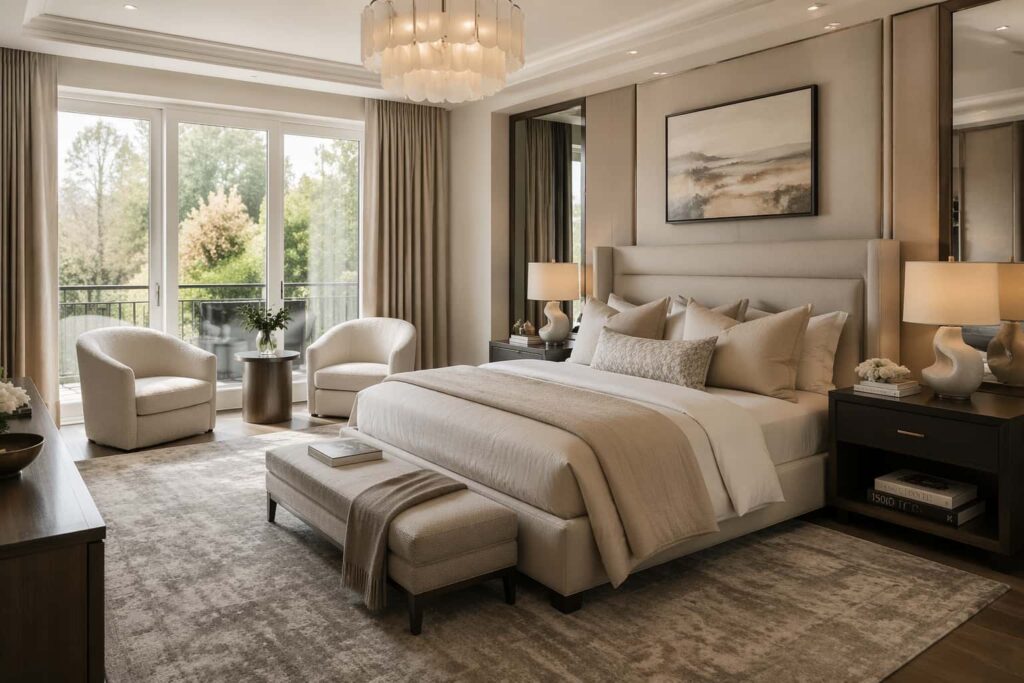
Chapter 3: The FF&E Specification Document (What It Should Contain)
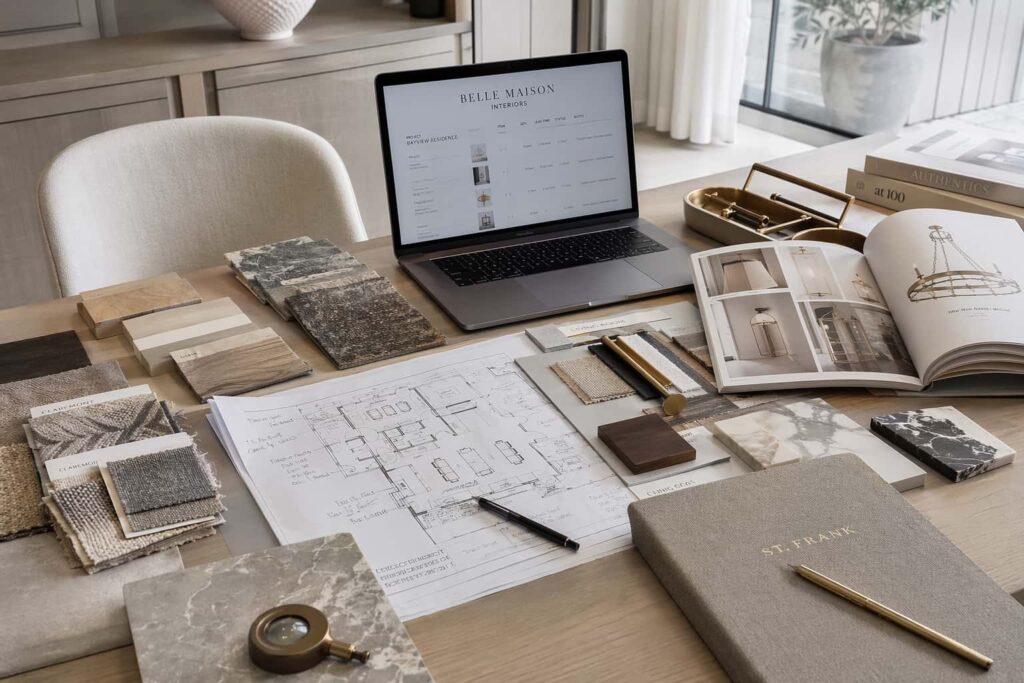
A proper FF&E specification is not a Pinterest board. It’s a technical document with:
| Section | Content | Why It Matters |
| Furniture Schedule | Piece name, dimensions, material spec, quantity, location | Prevents “I thought this was for the guest suite” errors |
| Finishes Schedule | Timber species, veneer cut, fabric reference, metal finish | Ensures workshop produces exactly what’s in the designer’s head |
| Lighting Schedule (freestanding only) | Lamp type, bulb spec, plug type, cord length | Overseas pieces need correct plugs/sockets |
| Artwork & Accessories | Dimensions, weight, hanging method, conservation requirements | Heavy pieces need wall reinforcement (not FF&E, but affects timing) |
| Procurement Schedule | PO date, sample approval, production start, estimated delivery | The project manager’s bible |
Fenmi Casa’s contribution: We provide a Manufacturing Specification Sheet for every bespoke piece — itemized materials, tolerances, finish references, and quality checkpoints. It attaches to the FF&E spec as an appendix.
Chapter 4: FF&E Budgets — Real-World Numbers
Numbers help. Here are real-world FF&E budgets for three villa project types (data from 40+ projects, 2023–2025):
| Villa Type | Total Interiors Budget | FF&E Budget | Notable Allocations |
| Beach house, 350㎡, Australia | AUD $1.8M | AUD $420K (23%) | 60% bespoke (local maker), 40% vintage |
| City villa, 280㎡, UK | £1.2M | £310K (26%) | 40% bespoke (EU makers), 60% design market |
| Mountain retreat, 450㎡, USA | $2.1M | $520K (25%) | 70% bespoke (including Fenmi Casa), 30% antique |
Where the money goes (typical FF&E budget breakdown):
| Category | % of FF&E Budget | Notes |
| Seating (sofas, lounge chairs) | 28–35% | Largest visual impact; highest comfort expectation |
| Dining (table + chairs) | 15–20% | Fewer pieces, higher per-piece cost |
| Bedroom (bed + nightstands + wardrobe) | 20–25% | Often the most bespoke-heavy category |
| Lighting (freestanding) | 8–12% | Often underestimated |
| Rugs & soft furnishings | 10–15% | Custom rugs = 12–20 weeks lead time |
| Artwork & accessories | 5–10% | Client’s own collection often fills this |
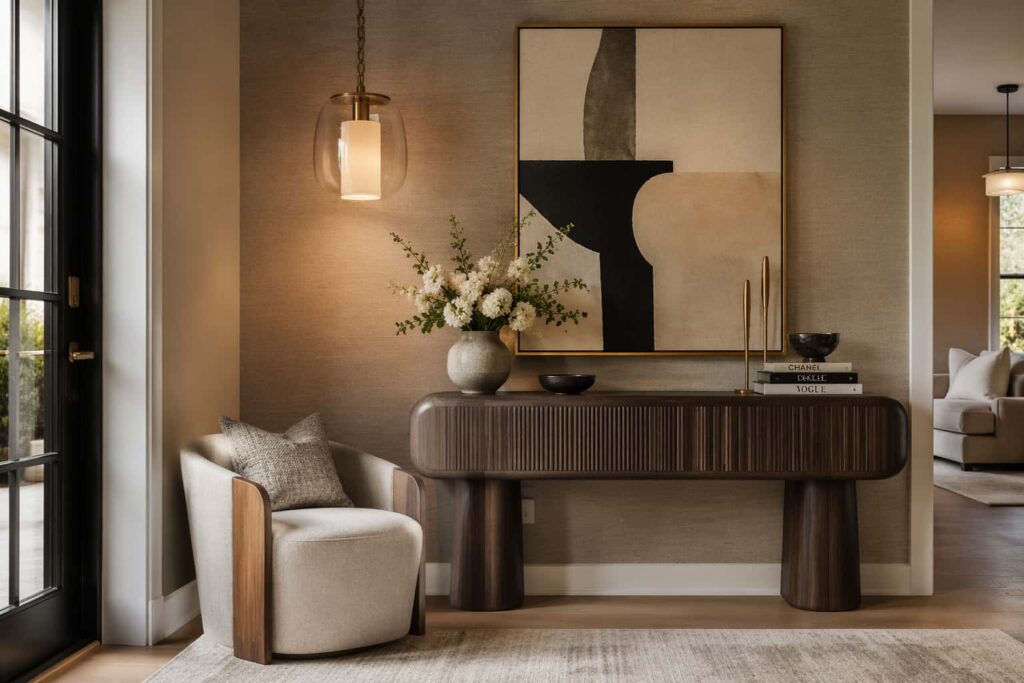
Chapter 5: Common FF&E Pitfalls (and How to Avoid Them)
| Pitfall | Symptom | Prevention |
| Scale mismatch | Villa has 4.5m ceiling; sofa is 800mm high — looks lost | Always draw furniture in situ (CAD or SketchUp) before specifying |
| Style drift | Homeowner adds 3statement pieces that don’t relate | Appoint a single style arbitrator (usually the designer) |
| Lead time naivety | “Can we get this in 8 weeks?” No. | Build 14-month lead time into the project program |
| Budget creep | “Since we’re doing bespoke, can we also do…” | FF&E spec goes through 2 rounds of value engineering before sign-off |
| Freight damage | Container arrives, 3 pieces damaged | Specify A-grade crating for pieces >$3,000; insurance = 110% of replacement value |
Chapter 6: Fenmi Casa’s Role in Your FF&E Specification
We don’t supply everything. And that’s deliberate. FF&E in a luxury villa is a curated mix: bespoke statement pieces (us), design-market supporting pieces (your network), and vintage/art (the homeowner’s contribution).
What Fenmi Casa provides within an FF&E specification: – Bespoke furniture designed to the villa’s exact dimensions and the designer’s material spec – Material passport for every piece (timber species, finish chemistry, foam certification, fabric source) – Coordination drawings showing how our pieces interact with adjacent fixed elements (built-in cabinetry, stone thresholds, lighting locations) – Logistics management including crating, freight, customs clearance, and white-glove delivery
What we don’t provide (but can recommend partners for): – Freestanding lighting (we recommend designers/brands by region) – Rugs and soft furnishings (we work with rug ateliers in India and Turkey) – Artwork and sculptural pieces (this is the homeowner’s domain)
Chapter 7: The Installation Day (What to Expect)
FF&E installation in a completed villa is a choreographed event. Here’s the typical sequence:
| Time | Activity | Who |
| Day -14 | Pre-installation walkthrough (verify access, floor protection, elevator booking) | PM + builder |
| Day -7 | Floor protection installed (corrugated board + breathable fabric) | Builder’s team |
| Day -3 | Climate stabilization (HVAC running 72 hours before delivery) | Builder |
| Day 1 (AM) | Large casegoods delivered (dining table, beds, wardrobes) | Delivery team + PM |
| Day 1 (PM) | Seating delivered (sofas, lounge chairs) | Delivery team + PM |
| Day 2 (AM) | Accessories, lighting, rugs | PM + styling team |
| Day 2 (PM) | Styling and photography | Designer + PM |
| Day 3 | Snag list review and handover | Designer + homeowner + PM |
Pro tip: Schedule HVAC commissioning before FF&E installation. Delivering a solid-timber dining table into a villa with 80% humidity is a recipe for joint failure within 6 months.
Conclusion: FF&E Is the Difference Between a House and a Home
The architecture gives you the stage. The fixed finishes give you the atmosphere. But the FF&E — the pieces you touch, sit on, eat at, and live with — that’s what makes it a home.
If you’re working on a villa project and the FF&E specification feels overwhelming, start with the pieces that matter most. Usually, that’s the dining table, the primary bedroom bed, and the sofa in the family room. Get those right, and the rest falls into place.
If you’d like to discuss a bespoke piece for your FF&E specification, email info@fenmicasa.com with the project drawings. We’ll respond within 24 hours with feasibility feedback — no commitment required.
FAQ
Q1: Is FF&E the same as “furnishings”? Not exactly. “Furnishings” is a broader, more casual term. FF&E is a professional specification category used by designers, procurement teams, andQuantity Surveyors. In a formal specification document, use FF&E; in conversation with a homeowner, “furnishings” is fine.
Q2: Who procures FF&E — the designer or the homeowner? In luxury villa projects, the designer typically leads procurement (sourcing, PO management, quality control). The homeowner approves the specification and pays the invoices (either directly to suppliers, or reimburses the designer). Clarify this division of responsibility in the engagement letter.
Q3: How much does bespoke FF&E cost vs. design-market pieces? Bespoke is typically 2–4× the cost of design-market pieces of comparable quality. A bespoke solid-walnut dining table (2.4m, seating 10): $8,000–$14,000. A comparable design-market piece (e.g., from a European brand): $3,000–$6,000. You’re paying for made-to-measure, not just quality.
Q4: Can FF&E be installed before the building is 100% complete? Ideally, no. Dust, solvent fumes from final painting, and trades moving through the space are all risks to completed FF&E. The safe sequence: building = 100% complete → HVAC commissioned → 72-hour climate stabilization → FF&E installation.
Q5: What’s the biggest mistake homeowners make with FF&E? Buying the hero pieces first (the statement sofa, the enameled dining table) before the rest of the specification is complete. These pieces then dictate the rest of the specification, and compromises follow. The correct sequence: complete the full FF&E specification → approve the budget → procure in the order of lead time (longest first).
Published by Fenmi Casa — where European design meets Chinese craftsmanship. Visit fenmicasa.com to download our FF&E Specification Template.