
The Villa That Charges Your Phone (Without You Noticing)
Three years ago, a designer friend in Sydney told me about a client complaint that still stings: “We spent $4 million on this villa, and I still have to crawl under the nightstand to plug in my phone.”
That complaintof the most common post-handover regrets in luxury residential projects. The furniture looks spectacular. The lighting is perfect. But the daily ritual of charging devices — phones, tablets, laptops, earbuds — remains stuck in 2010.
Smart furniture doesn’t mean a screen on every table. It means thoughtful integration of power and light into furniture pieces so that technology disappears into the design. This article covers what’s technically feasible today, what’s marketing fluff, and how to specify it properly.
Chapter 1: Wireless Charging — What Works and What Doesn’t
1.1 The Qi Standard (and Why It Matters)
Most premium Android phones and iPhones since iPhone 8 support Qi wireless charging (WPC standard). Furniture with built-in wireless charging must be Qi-certified, or charging speeds will be glacial.
| Charging Standard | Power Output | Compatible Devices | Furniture Integration Difficulty |
| Qi BPP (Baseline Power Profile) | 5W | Al older smartphones | ⭐ Easy — thin coil, low heat |
| Qi EPP (Extended Power Profile) | 15W | iPhone 12+, Samsung S-series | ⭐⭐ Moderate — needs active cooling |
| Qi2 (Magnetic Power Profile) | 15W | iPhone 12+ (MagSafe), Android (2025+) | ⭐⭐⭐ Hard — requires magnet alignment |
| Proprietary (Samsung/Fapple) | 9–15W | Brand-specific | ❌ Avoid — locks client into ecosystem |
1.2 Where to Integrate Wireless Charging
| Furniture Piece | Integration Location | Practical Considerations |
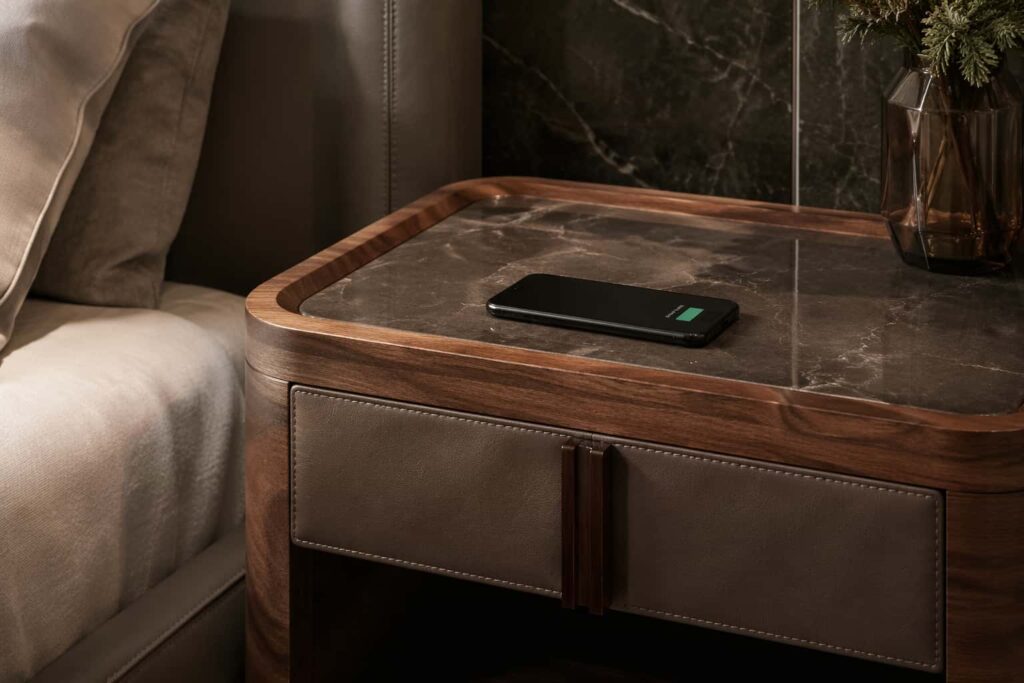
| Nightstand | Top surface, towards the headboard side | Must handle 15W + heat dissipation; active cooling fan noise <25dB |
| Coffee table | Inset into tabletop, 50mm from edge | Risk of keys/wallets with magnetic strips; specify “foreign object detection” |
| Desk/workspace | Inset, front third of worksurface | Needs cable management below; consider multiple coils for landscape tablets |
| Side table (lounge) | Top surface, offset from center | Best for occasional use; 5W sufficient |
1.3 The Heat Problem (and How to Solve It)
Wireless charging at 15W generates measurable heat — up to 15°C above ambient at the charging coil. In a walnut nightstand, that heat has nowhere to go.
Three engineering solutions:
- Active cooling (best): Small, low-noise fan (12dB–20dB) with intake from the back of the furniture piece. Adds $40–$80 to manufacturing cost.
- Thermal bridge (good): Aluminum heat sink embedded 5mm below the charging surface, dissipating heat to the furniture back panel. No moving parts, but limited to 10W charging.
- Air gap + vented panel (minimum): 3mm air gap between coil and surface, with vented back panel. Works for 5W only; 15W will throttle.
Fenmi Casa’s approach: For nightstands and desks, we use active cooling with the fan mounted to the back panel (not inside the drawer). The client never hears it, and 15W charging sustains indefinitely.
Chapter 2: Ambient Lighting Integration
Ambient lighting in furniture is not about reading lights (that’s task lighting). It’s about creating a mood — subtle illumination that makes a room feel inhabited even when no one is home.
2.1 LED Strip Specifications That Matter
| Parameter | Budget Spec | Premium Spec | Why It Matters |
| CRI (Color Rendering Index) | CRI >80 | CRI >95 | Low CRI makes wood look dead |
| CCT (Correlated Color Temperature) | Fixed 3000K | Tunable 2700K–4000K | Villa owners argue about warm vs. cool |
| R9 value | Not specified | R9 >90 | R9 measures red rendition; skin tones look better |
| Flicker | <30% (visible) | <5% (imperceptible) | Sove clients will notice 30% flicker |
| Driver | Non-dimmable | DALI-2 or 0–10V dimmable | Integration with Crestron/Control4 |
2.2 Integration Locations That Work
| Piece | Lighting Type | Effect | Installation Note |
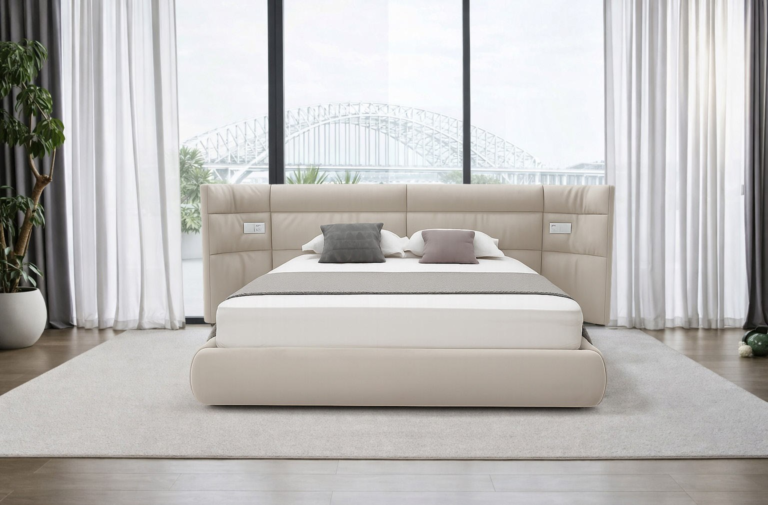
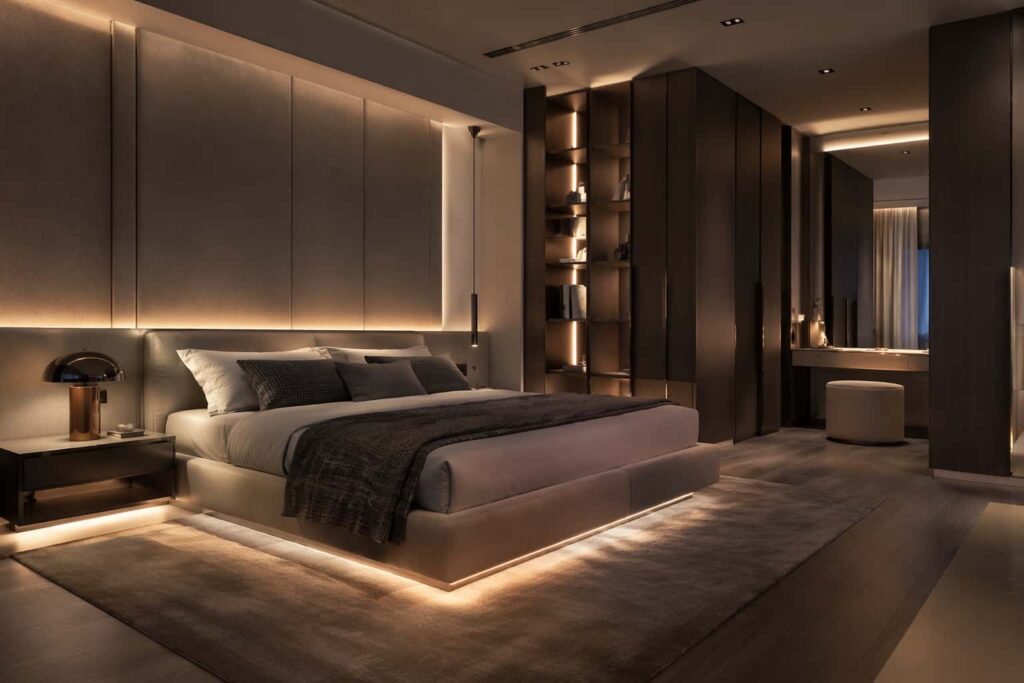
| Bed frame (headboard) | Indirect LED strip, downward | Soft wash on wall behind bed | Needs diffuser — bare LED looks cheap |
| Wardrobe (interior) | Motion-activated LED strip | Iluminates hanging clothes | PIR sensor reliability varies; test before specing |
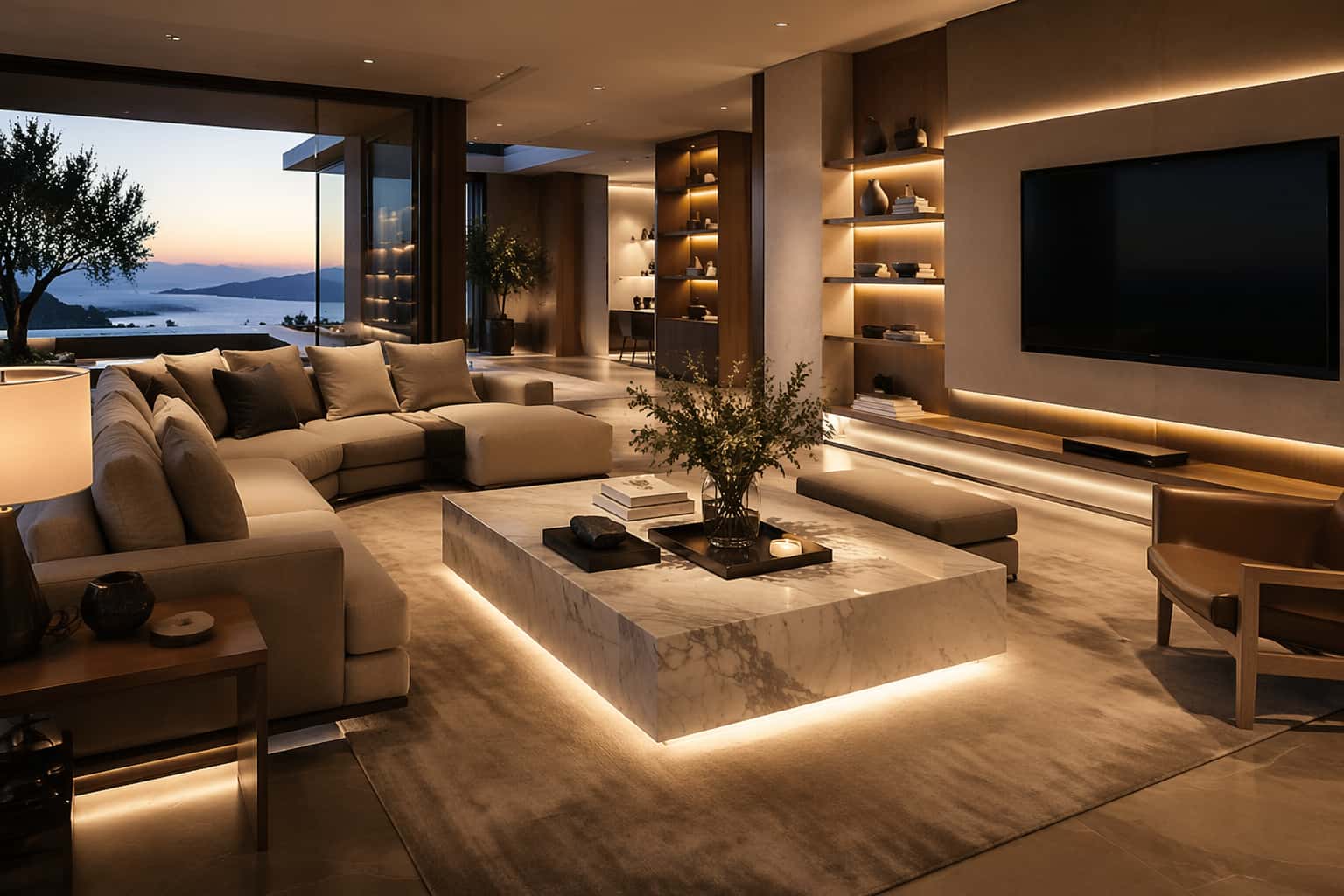
| TV console (plinth) | LED strip, floor wash | floating” effect at night | IP20 sufficient (indoor); cable exit through back panel |
| Dining table (base) | LED strip on base perimeter | Sculptural effect during dinners | Dim to 10% minimum; bright looks like a conference room |
| Coffee table (glass top) | Edge-lit LED | Glows through glass edge | Glass thickness >12mm; edge polish quality matters |
2.3 The “Dim to Zero” Problem
Many LED drivers claim “dimmable to 0%” but actually cut out at 5–10%. In a luxury villa bedroom, even 5% can be noticeable at night. Specify drivers with “smooth dim to 0%” or, better, a separate circuit for ambient vs. task lighting.
Chapter 3: Power Management — The Unglamorous but Essential Part
Smart furniture is only as good as its power architecture. A wireless-charging nightstand with a 15W coil, LED ambient lighting, and USB-C outlets needs 120W–200W of clean power. That’s a lot of current running through furniture.
3.1 Cable Management Standards
| Approach | Pros | Cons | Recommendation |
| Hidden cord (fixed) | Cleanest look; no visible cables | Requires proer installation; not field-adjustable | ✅ For built-in pieces |
| Cable passthrough (grommet) | Adjustable; easy to reconfigure | Visible cable at grommet | ⚠️ Acceptable for desks |
| Battery (rechargeable) | No cables at all | Needs charging every 3–7 days; battery replacement in 3–5 years | ❌ Not for luxury villas — client won’t maintain |
| Floor-level power outlet | Furniture plugs into wall; no internal wiring | Visible cord from furniture to wall | ⚠️ Use only if furniture is agaist wall |
3.2 Electrical Safety (Critical for Wood+Fabric)
Furniture-integrated electronics must meet IEC 60335-1 (household appliances) or UL 962 (household and similar electrical appliances). Key requirements:
- Creepage distance: 3mm minimum between live parts and accessible metal surfaces
- Touch current: <0.25mA (imperceptible)
- Abnormal operation test: Electronics must fail safely (no fire, no shock) when dust/otor ingress occurs
Practical tip: Ask the supplier for their third-party safety test report (SGS, TÜV, or Intertek). If they don’t have one, the electronics were not designed to any standard.
Chapter 4: Specifying Smart Furniture — A Designer’s Checklist
If you’re specifying smart furniture for a villa project, here’s the checklist we recommend you run through with every supplier:
| # | Question | Good Answer | Red Flag |
| 1 | “What Qi certification does the wireless charger have?” | “WPC Qi-certified, EPP 15W” | “Compatible with all phones” (vague) |
| 2 | “How is heat managed at 15W?” | “Active cooling, <25dB, sustained 15W” | “Passive heat sink” (will throttle) |
| 3 | “What is the LED CRI and R9 value?” | “CRI >95, R9 >90, test report attached” | “High-quality LED” (no numbers) |
| 4 | “Can the lighting be integrated with Crestron/Control4?” | “0–10V or DALI-2 driver included” | “App control only” (not whole-home) |
| 5 | “What safety certification do the electronics have?” | “IEC 60335-1 test report from SGS” | “CE marked” (self-declared, untrustworthy) |
| 6 | “What happens if the electronics fail in 3 years?” | “Replaceable power module; spare parts available 7 years” | “Whole piece needs replacement” |
| 7 | “Can I see the wiring diagram before ordering?” | “Yes, provided with shop drawings” | “Wiring is internal, not customer-accessible” |
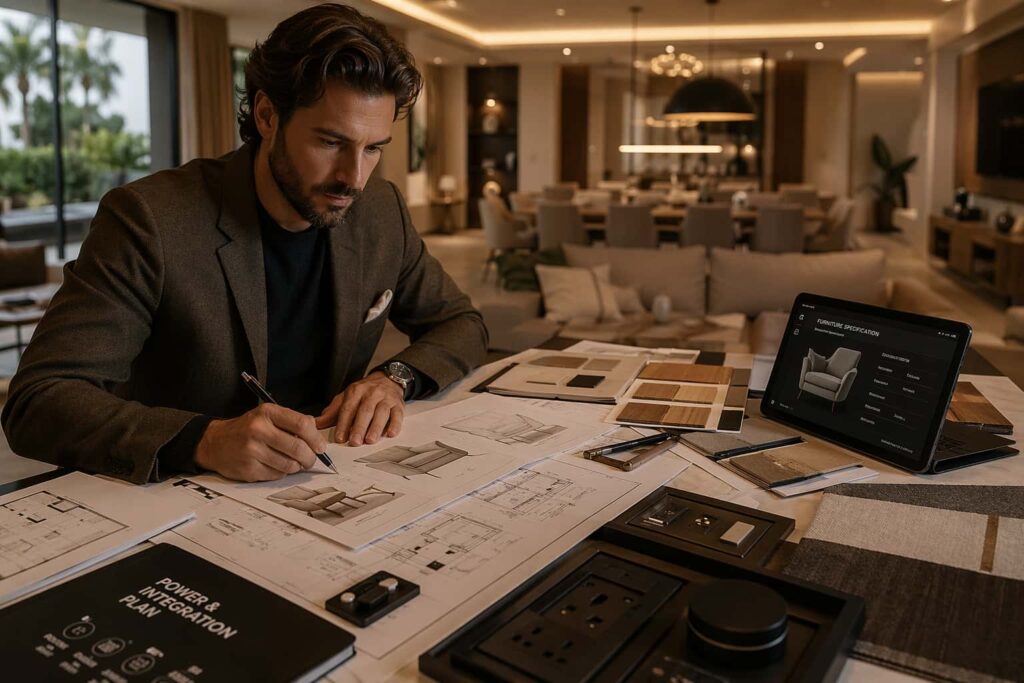
Chapter 5: Fenmi Casa’s Smart Furniture Offering
We don’t brand ourselves as a “smart furniture company” — that sounds like a Kickstarter project from 2016. Instead, we offer technology-integrated bespoke furniture as an option on any piece we manufacture.
Available integrations: – Wireless charging: Qi EPP 15W with active cooling; optional MagSafe-compatible magnetic alignment – Ambient LED lighting: CRI >95, R9 >90, tunable 2700K–4000K, DALI-2/0–10V dimmable drivers – Power management: Hidden cable routing, floor-level outlet integration, replaceable power modules – Control integration: Compatible with Crestron, Control4, and Savant whole-home systems
The process: 1. You send us the villa’s electrical plans and smart home specification 2. We produce integration drawings showing power routing, driver locations, and control interfaces 3. You review and approve (typically 1–2 rounds of revisions) 4. We manufacture and pre-test all electronics before shipping 5. On-site: our technician (or your electrician) connects the furniture to the villa’s electrical system
Warranty: 2 years on all electronics; spare power modules available for 7 years post-purchase.
If you’re working on a villa project with smart home integration, email info@fenmicasa.com with the electrical plans. We’ll propose an integration approach within 48 hours.
Conclusion: Technology Should Disappear
The best smart furniture is the piece your client uses every day without thinking about it. The phone charges when placed on the nightstand. The wardrobe lights up when the door opens. The TV console glows softly at 5% brightness during dinner.
None of it requires an app. None of it needs a firmware update. It just works — because the design, the electronics, and the craftsmanship were integrated from day one.
If this article helped you think through smart furniture integration, share it with a colleague who’s currently wrestling with a villa electrical plan. And if you have a project in mind, we’re here to help you get the integration right.
FAQ
Q1: Can wireless charging work through a stone or marble tabletop?
Yes, but with limitations. Qi wireless charging works through non-metallic surfaces up to 8mm thick. For stone tops >8mm, the supplier must use an extended-range Qi coil (up to 20mm), which generates more heat. We recommend a flush-mounted charging puck (protruding 2–3mm above the stone) for stone tabletops — it’s barely visible and charges reliably.
Q2: How do I integrate furniture lighting with a whole-home control system like Crestron?
Specify 0–10V or DALI-2 dimmable LED drivers (not TRIAC, which causes flicker). The furniture’s lighting circuit connects to the villa’s lighting control panel via a low-voltage cable. In the shop drawing phase, show the control interface clearly — Crestron programmers need to know the exact driver type to configure the system.
Q3: What happens if the wireless charger fails after 2 years?
In properly designed smart furniture, the wireless charging module is a replaceable cartridge, not a glued-in component. Fenmi Casa uses a snap-in module that a technician can replace in 10 minutes. When specifying smart furniture, ask: “Can the electronics be replaced without dismantling the furniture?” If the answer is no, walk away.
Q4: Is it safe to have wireless charging in a bedside table next to someone’s head all night?
Qi wireless charging produces non-ionizing electromagnetic fields (EMF) at frequencies around 100–200 kHz. The International Commission on Non-Ionizing Radiation Protection (ICNIRP) sets exposure limits far above what a furniture-integrated charger produces. That said, we recommend locating the coil towards the headboard side of the nightstand (away from where the client’s head lies) and disabling charging when the room’s ambient light sensor detects “sleep mode.”
Q5: How much extra does smart furniture cost vs. standard bespoke?
Wireless charging add-on: $80–$150 per location. Ambient LED lighting: $120–$250 per meter of LED strip (including driver and dimmer). Whole-home integration (Crestron/Control4 compatible): adds $300–$600 per piece for drivers and control interfaces. For a typical villa primary bedroom (nightstands + wardrobe + bench), the smart furniture premium is $1,500–$3,000 — roughly 8–12% of the furniture budget for that room.
Published by Fenmi Casa — European design, Chinese craftsmanship, thoughtful technology integration. Visit fenmicasa.com to download our smart furniture specification guide.