

The $3,000 Mistake That Starts with a PDF
Last year, a designer in Melburne sent us a beautiful PDF specification for a villa dining setting. Seven pages, professional layout, detailed dimensions. We quoted within 48 hours. Three weeks later — after production had started — the designer emailed: “The stone specified is not available in Australia. Can we switch to a different material?”
That change cost $3,200 in re-worked components and pushed the delivery date by 18 days.
The root cause wasn’t the stone choice. It was that the specification was incomplete — no material availability note, no alternates listed, no finish sample reference. A complete document set would have caught this before a single piece was cut.
This article lists the 8 documents every designer should prepare before requesting a quote from a Chinese furniture manufacturer. If you send all 8, you’ll get a precise quote, fewer surprises, and a smoother production process.
Document #1: Dimensional Drawing (Scaled, with Critical Dimensions Called Out)
A dimensional drawing is not a sketch on a napkin. It needs:
| Element | Requirement | Why It Matters |
| Scale | 1:50 or 1:20 (architectural) | Unscaled drawings lead to 10–20% dimensional errors |
| Critical dims | All width/depth/height in mm | “Standard size” means different things in different countries |
| Tolerance callout | ±3mm for bespoke, ±5mm for casegoods | Prevents disputes on “tight” vs. “loose” fit |
| Section views | For complex joinery (splayed legs, curved rails) | 2D plans alone don’t capture 3D complexity |
| Client signature | On the Final version | Prevents “I didn’t approve this dimension” disputes |
Fenmi Casa tip: We accept PDF, DWG (AutoCAD), or Rhoino 3DM. If you only have a hand sketch, our design team can produce a professional drawing for $150–$300 per piece (deducted from the order if you proceed).
Document #2: Material Specification Sheet
Vague material descriptions cost money. “Walnut finish” could mean veneer, solid wood, or a laminate that looks like walnut. Your material spec sheet should include:
| Material Type | Specification Detail Needed | Example (Good) | Example (Vague/Bad) |
| Solid timber | Species + grade + moisture content | “American Black Walnut, FAS grade, moisture 8–10%” | “Walnut wood” |
| Veneer | Species + cut + backing + thickness | “Walnut cathedral cut, 0.6mm on MDF backing” | “Walnut veneer” |
| Stone | Stone type + thickness + edge profile + finish | “Carrara marble, 20mm thick, eased edge, honed finish” | “Marble top” |
| Metal | Alloy + finish + thickness | “304 stainless steel, brushed satin finish, 1.5mm thickness” | “Stainless steel frame” |
| Fabric | Manufacturer + collection + color code | “Kavand 130025/42, 100% wool” | “Grey fabric” |
Pro tip: Attach a physical sample or a link to the manufacturer’s product page. For fabrics, a memo swatch (150×150mm) sent by courier eliminates 90% of color disputes.

Document #3: Finish Schedule (with Real-World References)
The biggest source of client dissatisfaction is finish mismatch. A “warm walnut” in a showroom in Milan looks different under the skylights of a Sydney villa.
Your finish schedule should include:
- Finish type (water-based poly, hardwax oil, solvent-based lacquer)
- Sheen level (matt, satin, semi-gloss — specify as % reflectance)
- Color reference (NCS code, RAL number, or a physical sample ID)
- Affected components (which parts get this finish)
| Finish Description | Acceptable | Better (Specify Numerically) |
| “Matt black” | ❌ | “Matt black, 10–15% sheen, RAL 9005” |
| “Natural oak” | ❌ | “Natural oak, hardwax oil, NCS S 1020-Y10R” |
| “Brushed brass” | ❌ | “Brushed brass, PVD coating, 0.8mm thickness” |
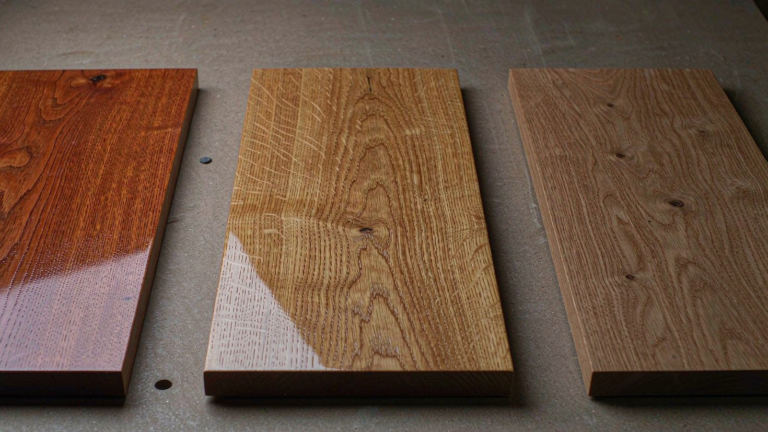
Fenmi Casa’s process: We produce a finish sample board (150×200mm) for every project and ship it to the designer for client approval before production starts. Cost: $50–$100 per board (credited against the order).
Document #4: Site Access Information
The most elegant dining table is useless if it doesn’t fit through the doorway. Your site access document should cover:
| Access Factor | Measurement Needed | Typical Issue |
| Doorway width | Minimum clear width (mm) | Piece 10mm too wide → cannot deliver |
| Elevator dimensions | Width × depth × door opening (mm) | Piece fits through door but not in lift |
| Stairwell access | Width + any 180° turn points | U-shaped stairwell blocks long pieces |
| Floor protection | Type (carpet, hardwood, marble) | Delivery team needs floor protection protocol |
| Delivery window | Allowed days/times | Villa gated community — delivery only Thu 9–11AM |
Checklist for the site visit: – [ ] Measure all doorways on the delivery path (not just the front door) – [ ] Check elevator dimensions (if applicable) – [ ] Photograph the delivery path (helpful for the delivery team) – [ ] Note floor types (marble = requires 6mm plywood + felt padding)

Document #5: Packing and Shipping Specification
Export packaging is not standard domestic packaging. If you don’t specify it, the factory will use the cheapest option — and insurance claims for damaged furniture are painful.
| Packing Level | Description | When to Specify |
| Standard export | 5-ply carton + corner protectors | Small accessories, low-value items |
| Enhanced export | Carton + 10mm foam + corner protectors | Table lamps, small side tables |
| Crate (A-grade) | Plywood crate, 12mm thickness, foam-lined | Large casegoods, stone tops |
| Custom crate | Engineered for specific piece, foam molding | Mirrors, glass, high-value items |
Essential shipping documents to request: – Commercial invoice (for customs) – Packing list (itemized) – Certificate of Origin (often required for customs duty assessment) – FSC certificate (if timber is FSC-certified)
Document #6: Hardware and Mechanism Schedule
If your design includes moving parts (drawers, doors, lift mechanisms), the hardware specification must be explicit. “Soft-closing drawer” is not a specification — it’s a hoped-for outcome.
| Hardware Type | Specification Detail | Recommended Brands (Available in China) |
| Drawer slides | Full-extension, soft-close, load rating | Blum, Hettich, DTC (good value) |
| Hinges | Soft-close, opening angle, mounting plate type | Blum Clip top, Hettich Sensys |
| Gas lift (ottoman) | Load rating, stroke length, certified | Suspa, Stabius (OEM in China) |
| Casters | Load rating, braking type, floor protection | Tente, Colson (available via import) |
Why it matters: A drawer slide rated for 25kg that actually carries 35kg will fail within 18 months. Specifying the right hardware upfront avoids callback costs.

Document #7: Quality Inspection and Acceptance Criteria
If you don’t define “acceptable quality,” the factory’s definition will apply — and it may not match yours.
| Quality Aspect | Acceptable Standard | Measurement Method |
| Veneer matching | Book-matched, grain aligned at joints | Visual inspection, 1m distance |
| Finish evenness | No orange peel, no drip marks | Visual + touch, ragged fingernail test |
| Dimensional accuracy | ±3mm on critical dims | Steel rule, caliper |
| Color match | ΔΕ <2.0 vs. approved sample | Colorimeter (if critical) |
| Structural integrity | No racking >3mm on diagonal test | Racking test (apply 50kg lateral force) |
Recommendation: Include a pre-shipment inspection clause in your purchase order. Cost: $300–$600 for a third-party inspector (SGS, Intertek, or local equivalent). Worth every cent.
Document #8: Project Timeline and Milestone Schedule
Finally, a realistic timeline prevents the “we need it in 4 weeks” conversation that compromises quality.
| Milestone | Typical Duration | Depends On |
| Drawing approval | 3–7 days | Your client’s decision speed |
| Prototype (if required) | 2–3 weeks | Complexity of first piece |
| Production lead time | 4–8 weeks | Number of pieces, finish complexity |
| Quality inspection | 1–2 days | Your inspector’s availability |
| ** Shipping (ocean)** | 25–40 days | Destination port |
| ** Customs + delivery** | 7–14 days | Customs clearance speed |
Build in buffer: Add 2 weeks to whatever timeline the factory quotes. Ocean freight gets delayed. Customs holds shipments. Your client’s interior painter runs 10 days late. The buffer saves relationships.
Conclusion: Complete Documents = Smooth Projects
The $3,000 mistake I described at the start? It could have been avoided if the specification included a material availability note and alternative material options — two of the 8 documents listed above.
If you’re preparing a specification for a villa project and want a second pair of eyes on it, email info@fenmicasa.com. We’ll review your document set for completeness — no obligation, no sales pressure. And if you’d like us to quote, we’ll respond within 48 hours with a detailed, itemized proposal.
Next step: Download our Furniture Specification Template — a blank DOCX you can use for your next project.
FAQ
Q1: Do I really need all 8 documents for a small order (2–3 pieces)?
For 2–3 pieces, Document #1 (dimensional drawing) and Document #3 (finish schedule) are essential. The others matter more as order size and complexity increase. That said, even a 2-piece order benefits from Document #5 (packing spec) — you don’t want a stone top arriving in a cardboard box.
Q2: What if I don’t have professional drawing software (AutoCAD, etc.)?
Hand sketches with clear dimensions (in mm) are acceptable for straightforward pieces. For complex joinery, hire a draftsperson (cost: $200–$400) or ask the manufacturer to produce shop drawings from your sketch (Fenmi Casa offers this service).
Q3: How detailed does the material specification need to be?
Specific enough that two different factories would quote the same materials. “Oak veneer” is not specific enough — one factory will quote crown cut, another quarter cut, and the results will look different. “European Oak, quarter cut, 0.6mm veneer on MDF” is specific.
Q4: Can I skip the site access document for a renovation (not new build)?
No — renovations are harder than new builds because existing doorways, elevators, and stairwells may not have been designed for furniture delivery. Always measure the actual delivery path, not the architectural plans (which may not reflect as-built conditions).
Q5: What happens if I don’t specify packing, and the furniture arrives damaged?
You’ll file an insurance claim — which requires proving the damage was due to inadequate packaging, not transit handling. If you didn’t specify export crating, the insurer may deny the claim. Specifying packing in writing (Document #5) protects you.
Published by Fenmi Casa — where European design meets Chinese craftsmanship. Visit fenmicasa.com to download our Furniture Specification Template.